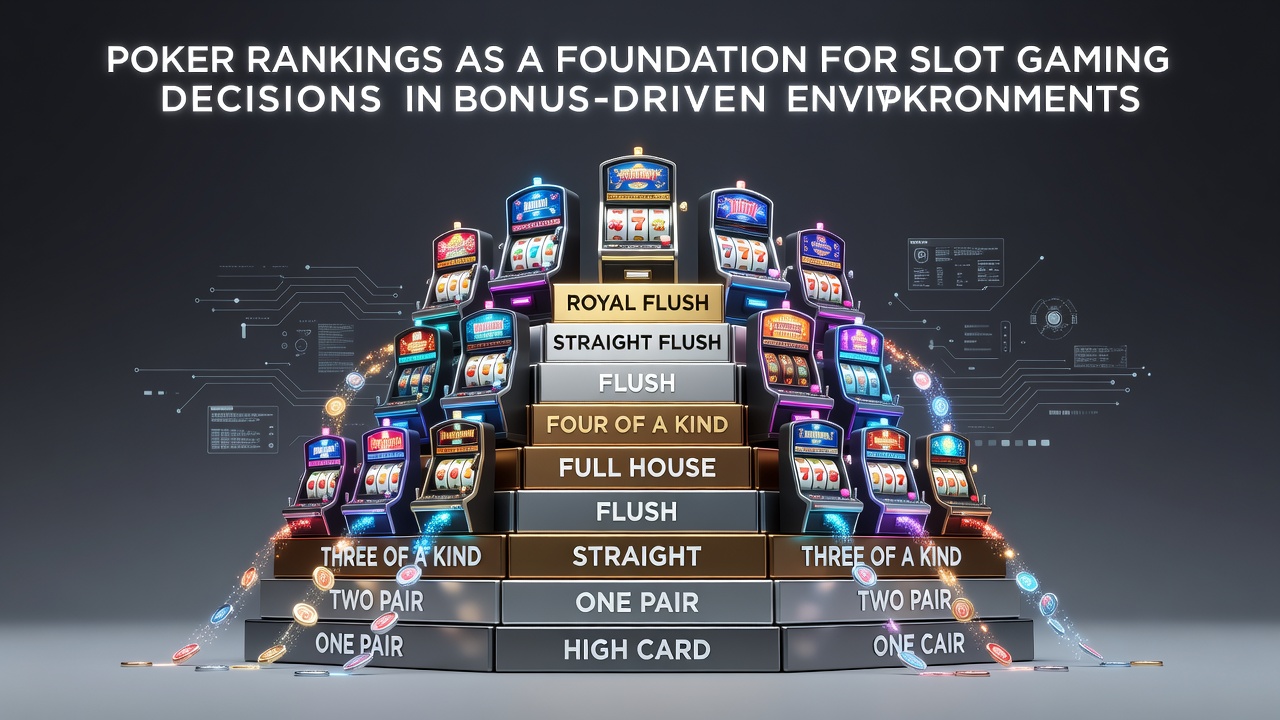
Poker Rankings Informing Slot Decisions in Promotional Bonus Settings
Standard poker hand rankings establish a clear hierarchy of probabilities that many observers note carries over into broader casino probability assessments, including those applied when selecting slot titles during periods of active bonus promotions. Royal flush sits at the apex with its one-in-649,739 odds in five-card draw, followed by straight flush, four of a kind, full house, flush, straight, three of a kind, two pair, one pair, and high card completing the sequence. Researchers at institutions tracking gaming mathematics have documented how familiarity with these exact frequencies sharpens a player's ability to evaluate risk tiers across different game formats.
Core Poker Hand Structure and Probability Data
Each ranking corresponds to fixed combinatorial values derived from a 52-card deck, and studies published through academic outlets show that repeated exposure to these figures improves numerical intuition for other random events. A full house occurs once every 694 hands on average, while a flush appears once every 508 hands, according to aggregated tables maintained by state-level oversight bodies such as the Nevada Gaming Control Board. Players who internalize these ratios often transfer the same comparative thinking when scanning slot paytables and volatility indicators during bonus rounds.
Transferring Analytical Habits to Slot Selection
Slot machines operate on independent RNG cycles, yet the decision framework built from poker rankings assists in distinguishing between high-volatility titles that demand larger bankroll buffers and lower-volatility options suited to extended bonus wagering periods. Data collected by the Australian Gambling Research Centre indicates that participants who regularly review probability tables allocate bonus funds more evenly across game libraries. This pattern appears because poker training emphasizes expected value calculations that translate directly into assessing a slot's return-to-player percentage against specific wagering multipliers attached to June 2026 promotional campaigns across multiple jurisdictions.
One documented case involved a cohort tracked by university researchers who applied poker-derived ranking logic to filter slot choices; the group demonstrated measurable consistency in preserving bonus balances longer than control participants. The same methodology helps identify when a slot's bonus feature frequency aligns with remaining wagering requirements, since both poker odds and slot hit rates rest on transparent mathematical distributions rather than intuition alone.
Bonus Environment Variables and Ranking-Informed Filters
Bonus-driven environments introduce additional layers such as playthrough multipliers, game contribution percentages, and time limits that reward systematic filtering. Observers tracking North American casino traffic patterns report that individuals versed in poker hierarchies tend to prioritize titles where the base game hit rate supports steady accumulation toward the multiplier target. Figures released by the Pennsylvania Gaming Control Board in early 2026 reveal average contribution rates for video slots hover between 70 and 100 percent, prompting players to cross-reference these percentages against their remaining poker-informed risk tolerance before committing funds.
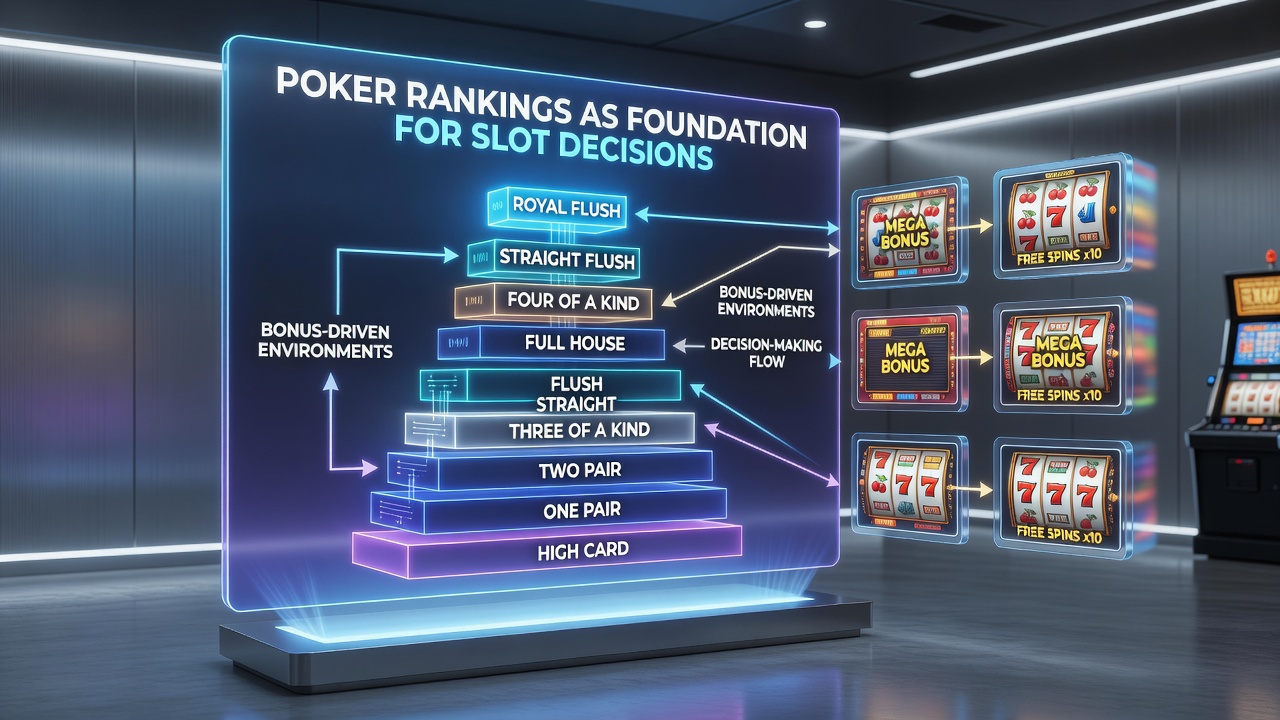
Free spin packages attached to deposit bonuses further illustrate the connection, as the fixed number of spins carries its own distribution curve comparable to drawing specific card combinations. Those who've studied poker hand frequencies often calculate the likelihood of triggering additional spins within the allotted rounds, then compare that figure to the slot's published bonus round payout ranges. Such calculations mirror the step-by-step ranking assessment used when deciding whether to chase a straight draw or fold in a poker hand.
Regulatory Context and Market Data as of June 2026
June 2026 marks the implementation window for updated game disclosure rules in several Canadian provinces, requiring clearer display of volatility indices alongside standard RTP figures. Industry reports from the Canadian Partnership for Responsible Gambling note that these disclosures enable more precise mapping between poker-style probability awareness and slot selection under bonus constraints. Players can now access standardized volatility labels that function similarly to hand-strength categories, allowing quicker alignment between available bonus terms and machine characteristics.
Cross-border comparisons compiled by the European Gaming and Betting Association further show that markets enforcing transparent bonus mechanics see higher retention of players who apply structured decision models derived from traditional card games. The consistency arises because both poker rankings and slot metrics ultimately reduce to countable outcomes within defined sample spaces.
Conclusion
Poker hand rankings supply a foundational probability vocabulary that continues to shape analytical approaches in slot environments shaped by promotional bonuses. Fixed combinatorial frequencies from five-card poker translate into comparative evaluation of RTP, volatility, and wagering multipliers, supporting objective filtering of available titles. Regulatory disclosures emerging in 2026 across multiple regions reinforce this transfer by standardizing the data points players already assess through a poker-informed lens. The result is a measurable continuity between card-game mathematics and slot decisions that remains grounded in verifiable distributions rather than subjective preference.